(Job 8 | Chapter VII of Jessie Penn-Lewis’s *The Story of Job*)
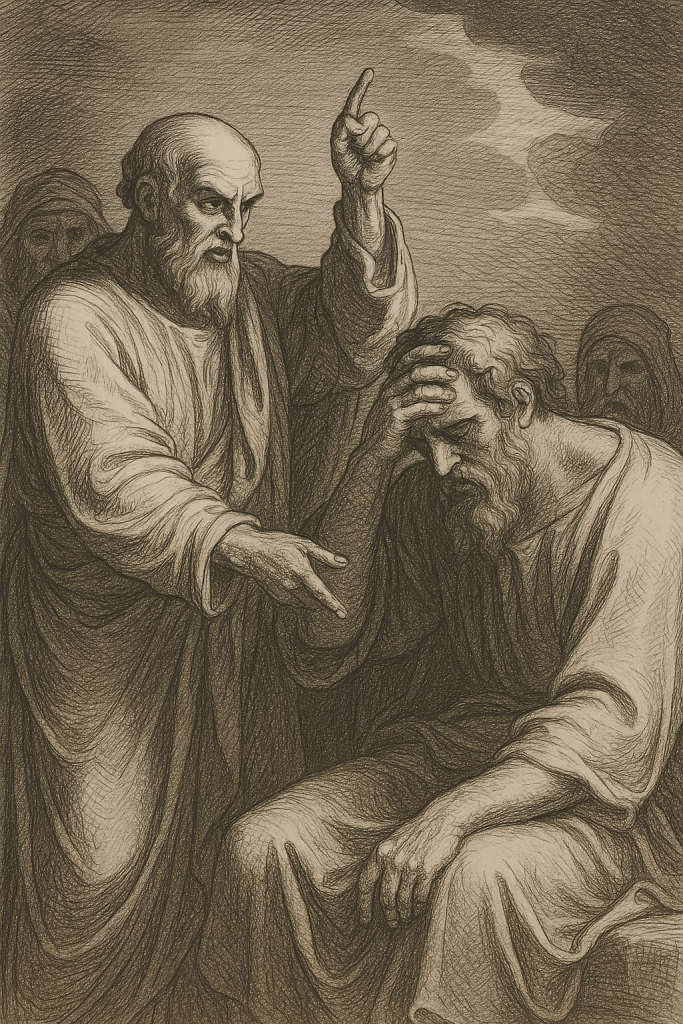
“If thy children have sinned against him, and he have cast them away for their transgression…” —Job 8:4 (KJV)
If Eliphaz was subtle, Bildad is blunt.
He opens his mouth and strikes where it hurts most:
“If your children have sinned against God, He cast them away for their transgression.”
It is a stunning blow.
He has no proof. No compassion. Only assumption—wrapped in the language of orthodoxy.
Jessie Penn-Lewis notes:
“Bildad’s theology is rigid, his tone hard. He speaks truth, but applies it as a sword to the wound, not a balm.”
Truth Turned Into Accusation
Bildad’s premise is that God is just—therefore Job’s loss must be judgment.
“Doth God pervert judgment? or doth the Almighty pervert justice?” (v.3)
The answer is no—but the application is cruel. He implies:
Your children died because they were sinners.
You suffer because you won’t repent.
What Bildad cannot comprehend is that a just God may allow suffering for reasons deeper than retribution.
The Spirit of the Pharisee
Bildad sounds familiar.
He mirrors the logic of the disciples in John 9: “Who did sin, this man or his parents?”
In his system, there is no room for mystery. No space for divine testing. No allowance for innocent grief.
Penn-Lewis writes:
“It is easy to quote doctrine. It is harder to kneel beside a mourner and keep silent.”
When Doctrine Becomes a Weapon
Bildad says:
“If thou wert pure and upright; surely now he would awake for thee…” (v.6)
It’s another wound—asserting that God’s silence is proof of Job’s impurity.
This is the danger of theology detached from compassion:
It assumes the role of God.
It not only declares what’s true—but pronounces who’s guilty.
Penn-Lewis’s Insight
“These men were speaking out of an unbroken spirit—proving that their knowledge of God was shallow, though their words were lofty.”
Bildad’s words reflect doctrine—but not discernment. Truth becomes cruelty when wielded by the proud.
Overcomer’s Checkpoint
1. Have I ever used scripture as a tool to correct, rather than to comfort?
2. Do I leave space in my theology for the mystery of righteous suffering?
3. How can I speak truth without harming the already broken?
“Truth, when handled by the unbroken, becomes a hammer—not a healing hand.” —Jessie Penn-Lewis