Series: Twisting the Scriptures — Post 22
“All scripture is given by inspiration of God, and is profitable for doctrine, for reproof, for correction, for instruction in righteousness:” — 2 Timothy 3:16 (KJV)
Introduction
There is a subtle danger in quoting the Bible — and it’s not the quoting that’s the problem.
It’s when a verse is isolated — pulled from its God-given context and used to say something it was never intended to say.
This method, known as Text Isolation, is one of the most common forms of Scripture twisting. A verse may be true in itself, but when separated from its surroundings, it can be misapplied, misunderstood, or even weaponized.
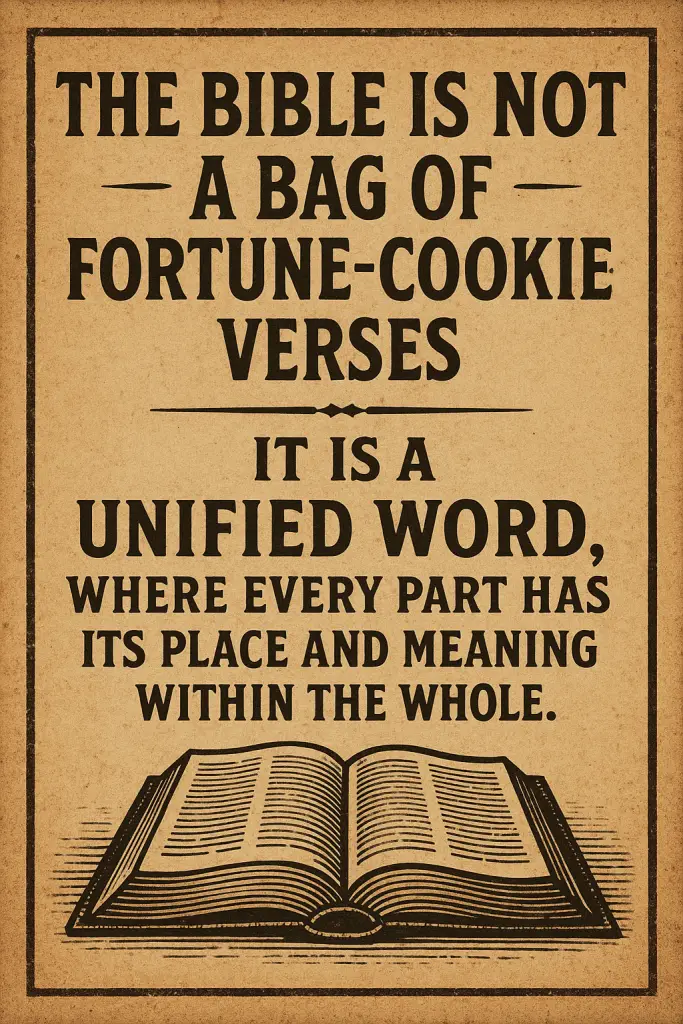
The Bible is not a bag of fortune-cookie verses. It is a unified Word, where every part has its place and meaning within the whole.
What Is Text Isolation?
Text Isolation happens when:
– A single verse is lifted out of a passage and given a new meaning.
– A phrase is quoted without regard to its context — historical, grammatical, or doctrinal.
– A truth is exaggerated into an error by ignoring balancing scriptures.
For example, quoting “Judge not” (Matthew 7:1) as a universal gag order against all spiritual discernment ignores the rest of the passage — which goes on to command us to judge righteous judgment (John 7:24), remove the beam from our eye, and beware of false prophets (Matthew 7:15).
The problem is not the verse. The problem is how it’s being used — or misused.
Why It’s Dangerous
When we isolate Scripture:
– We open the door to error. A partial truth out of context can become a total lie.
– We silence God’s full counsel. The Holy Ghost inspired not just verses, but paragraphs, stories, and entire epistles.
– We manipulate rather than submit. We use the Bible to serve our point, instead of seeking God’s.
Satan himself used isolated scripture when tempting Jesus in the wilderness. He quoted Psalm 91 — but Jesus answered him with scripture rightly applied (Luke 4:10–12).
Examples of Isolated Verses
“Where there is no vision, the people perish…” (Proverbs 29:18)
Often quoted to promote human goals or business plans — but the full verse says, “…but he that keepeth the law, happy is he.” This is about divine revelation, not ambition.
“I can do all things through Christ…” (Philippians 4:13)
Applied to everything from sports victories to career success — but Paul was talking about enduring lack and suffering, not self-empowerment.
“Give, and it shall be given unto you…” (Luke 6:38)
Ripped from Jesus’ teaching on mercy and forgiveness, this verse is often twisted into a financial promise.
When a verse is cut loose from its anchor, it may float — but it no longer points to Christ.
How to Guard Against It
1. Read the whole passage. Don’t stop at the verse — study the chapter, the speaker, the audience, and the purpose.
2. Let Scripture interpret Scripture. Use cross-references to see how God speaks consistently.
3. Pray for discernment. The Holy Spirit will lead you into all truth — not isolated truths.
4. Don’t rush. Meditate on the Word. Many twisting errors come from haste, not heresy.
Word for the Overcomer
“Whom shall he teach knowledge? and whom shall he make to understand doctrine? them that are weaned from the milk…” — Isaiah 28:9 (KJV)
The overcomer is not swayed by half-truths. He loves the whole counsel of God.
He doesn’t feed on isolated scraps — he eats the whole loaf.
Stand firm. Read deeply. Let God’s Word interpret itself.
And don’t settle for a verse when God has given you the volume of the book.