A Study of How the Apostles Teach Us to Read the Bible
A study series from The Overcomer, now also available as a free book from The Overcomer Press.
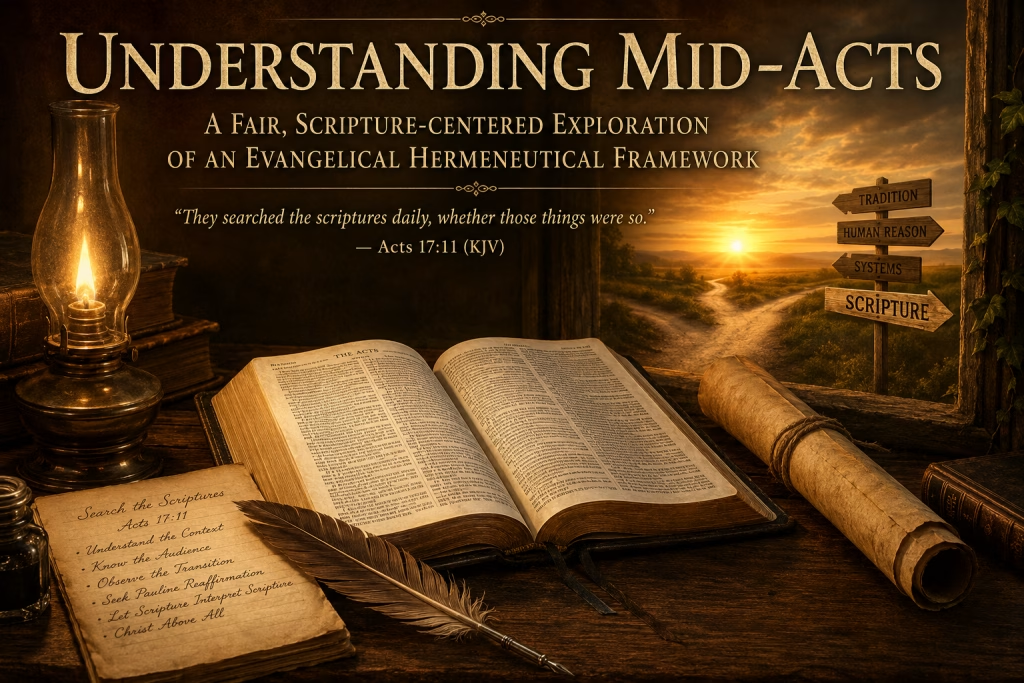
Questions about Israel and the Church have occupied Bible students for generations. When did the Church begin? To whom was the Great Commission given? Is water baptism intended for believers today? How should we read Hebrews, and how does Paul’s ministry relate to that of the Twelve? Mid-Acts Dispensationalism answers these questions from a coherent framework for reading the whole Bible, not from a loose collection of separate doctrines.
This series sets out that framework in the words of its own teachers before testing it against Scripture. Where Mid-Acts teachers differ, the differences are acknowledged rather than hidden under a general description of the movement. The views of individual teachers are kept distinct from my own conclusions.
The study rests on four commitments:
- Understanding before evaluation. We hear a position out before we weigh it.
- Scripture above systems. Every framework, including our own, must answer to the text.
- Charity without compromise. We disagree as brethren, without softening the truth.
- Christ above all. No system of interpretation should displace the Lord Himself as the center of our understanding.
One question runs through the whole series. Does the New Testament present the “mystery” as a second redemptive program, or as God’s eternal purpose fulfilled in Jesus Christ?
How to read this series. Keep an open Bible beside each post. When Peter, James or Paul appeals to Moses or the prophets, turn back to the passage he cites and read it in its setting. Then return to the apostle’s argument and consider what he draws from it. That practice will help you weigh my conclusions as well. Longer chapters are divided into parts at natural breaks in the argument. All Scripture is quoted from the King James Version.
Read the complete book. Understanding Mid-Acts Dispensationalism (152 pages) includes a chart comparing Mid-Acts positions, a reading timeline in Acts, a glossary, Sources and Notes, and Scripture and Subject indexes. Read or download it free on the Books page
Contents
Section One: Understanding the Framework
- Why Study Mid-Acts? — A Berean Invitation to Understand Before We Evaluate [link]
- The Interpretive Engine — How Mid-Acts Reads the Bible [link]
- The Foundational Distinctions — How the Central Mid-Acts Convictions Shape Its Conclusions [link]
- Mystery and Prophecy — What Was Hidden, and What Was Promised?
Section Two: Walking Through the Architecture
- Acts: The Great Transition — What Kind of Transition Does Luke Describe?
- Part 1: Pentecost, Stephen, and Saul’s Calling
- Part 2: Cornelius, Antioch, and How the Book Ends
- One New Man — The Cross and the Church’s Identity in Christ
- Part 1: Christ Our Peace: From Two to One
- Part 2: Fellowcitizens and One Access to the Father
- Preserving Distinction or Proclaiming Union? — The Fundamental Hermeneutical Divide
- Part 1: Two Ways of Reading, and Galatians
- Part 2: When Paul Withstood Peter
- Romans 9–11 and the Faithfulness of God — The Remnant, the Olive Tree, and the Mercy of God
- Part 1: Israel’s Privileges and the Remnant According to Grace
- Part 2: One Olive Tree, and “All Israel Shall Be Saved”
- Acts 15 and Amos 9 — The Jerusalem Council and the Promise to David
- Part 1: Peter’s Testimony and James Opens the Prophets
- Part 2: David’s Fallen Tabernacle and What the Council Decided
- The New Covenant — Promise, Participation, and Fulfillment in Christ
- Part 1: The Promise, the Blood, and Paul’s Ministry
- Part 2: The Covenant Cup and Strangers Brought Near
- Hebrews — Audience, Salvation, Warning, and Christian Application
- Part 1: The Readers, the Salvation, and the Better Priesthood
- Part 2: The New Covenant, the Heavenly City, and the Warnings
Section Three: Testing the Conclusions
- When Did the Church Begin? — Chronology, Union, and the Body of Christ
- Part 1: The Cross, Pentecost, and “the Beginning”
- Part 2: Paul as a Pattern and the Turning Points in Acts
- Israel and the Body of Christ — Distinction, Union, and the One Body in Christ
- Part 1: The Olive Tree and Those Made Nigh
- Part 2: Different Apostles, One Body, and Israel Still Matters
- Water Baptism — The Gospel, the Sign, and the Saving Work of Christ
- Part 1: Pentecost, and What Paul Said to Corinth
- Part 2: Paul’s Practice, “One Baptism,” and Peter’s Strong Words
- The Great Commission — Who Was Sent to the Nations—and With What Gospel?
- Part 1: Israel First, and What the Risen Lord Told Them to Preach
- Part 2: From Jerusalem to the Nations, and Why Paul Was Called
- Part 3: Peter, Paul, and Matthew 28
- Rightly Dividing the Word of Truth — What Did Paul Actually Tell Timothy to Do?
- Part 1: The Command in Its Own Setting
- Part 2: The Scriptures Timothy Already Knew
- Part 3: Mystery, Prophecy, and a Workman Approved
- Paul’s Epistles and the Rest of the Canon — Where Does the Church Receive Its Doctrine?
- Part 1: Paul’s Authority and What Peter Says About Paul
- Part 2: One Foundation and the Whole Apostolic Witness
- Does Audience Limit Christian Application? — From the First Hearers to the Life of the Church
- Part 1: “Our Learning”
- Part 2: The Wilderness, the Oxen, and the Words of Jesus
- Part 3: Peter, James, Paul, and Christian Obedience
Section Four: Final Reflections
- What We Have Learned from Mid-Acts Dispensationalism — Distinctions, Fulfillment, and the Witness of the Apostles
- Part 1: Right Questions and Unproved Separations
- Part 2: Paul with the Apostles, and Right Division in Practice
- Epilogue — Holding Fast to Christ — A Pastoral Word on Truth, Fellowship, and the Life We Share in Him
- Part 1: People, Frameworks, and the Words of Christ
- Part 2: Discernment, Unity, and Holding Fast to the Head
Links will be added as each part is published.